MAAC is now a consultancy-only organization. We advise film, television, and video game projects on cultural authenticity for Middle Eastern, North African, and Southwest Asian storylines. Scroll down to see the numbers behind our impact.

DISRUPT & ADVANCE
After ten years of building and educating the industry on the MENA and MENASA category in entertainment, MAAC has transitioned to a consultancy-only model. Alongside a team of academic experts, we advise streamers, networks, and film and video game companies on creating accurate, authentic Middle Eastern, North African, and Southwest Asian (MENA-SWANA) portrayals.

78%
of MENA characters on television are portrayed as trained terrorists/agents/soldiers or tyrants, exacerbating the stereotype of MENA persons as threats.
per “Terrorist & Tyrants” Study presented by MAAC.
0 0 0
ZERO MENA Leads in Film
ZERO MENA Female Film Writers
ZERO MENA Female Film Directors
We have spearheaded all research for MENA artists beginning in 2018. Regardless of the advocacy, in 2024 UCLA reported similar numbers showing the lack of growth for MENA-SWANA artists both in front of and behind the camera.
92
out of the top 100 films in 2019 had no Middle Eastern North African (MENA) females in them. Complete erasure of women-of-color on screen can be seen across all racial/ethnic groups measured, whilst white females were only erased from 7 movies.
The Epidemic of Invisibility in Film, per USC Annenberg’s Impact Report

MENA-SWANA ACCELERATION LABS
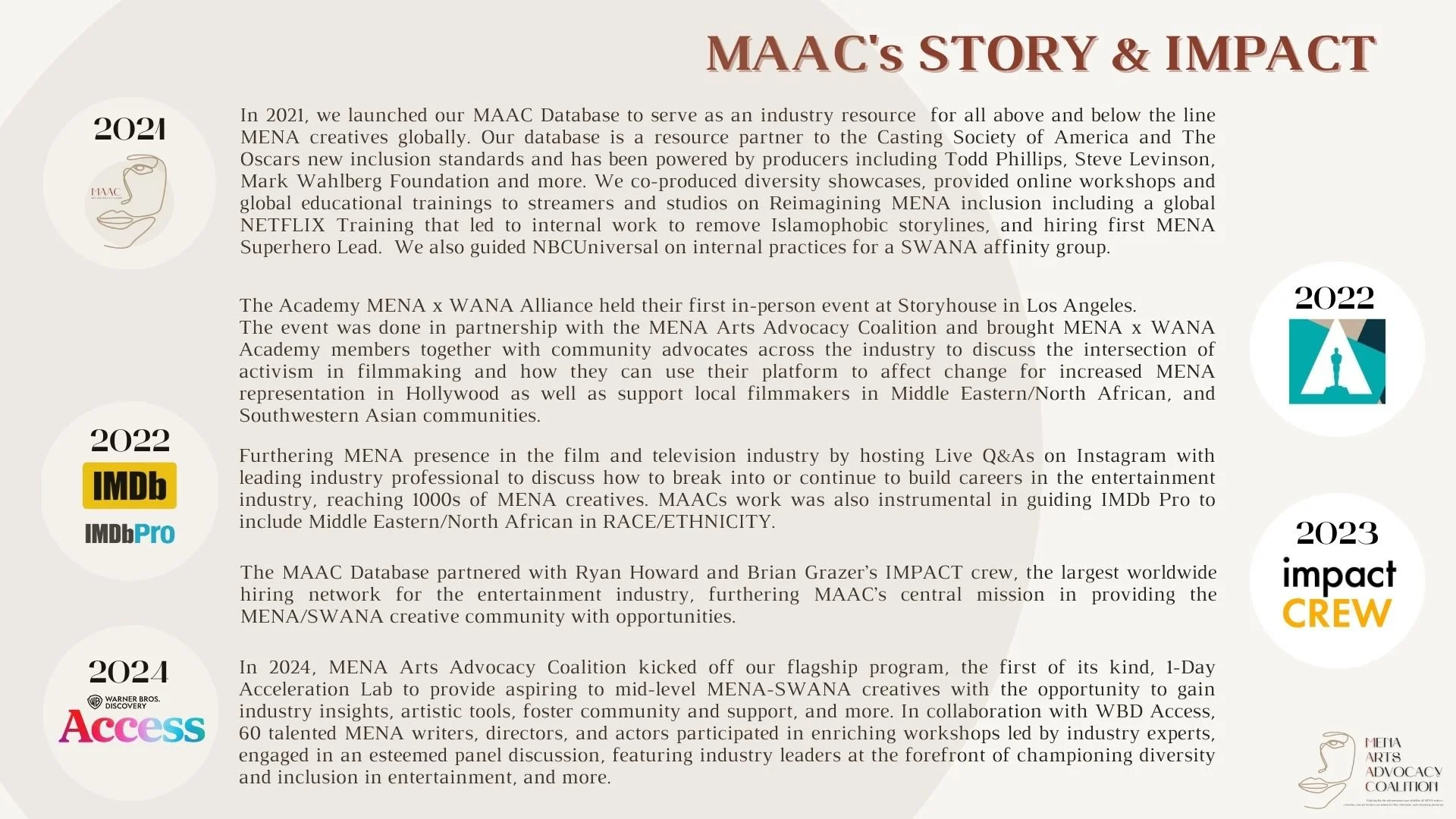
A first of its kind lab to provide aspiring to mid-level MENA-SWANA creatives with the opportunity to gain industry insights, artistic tools, foster community support, and more; featuring expert led panels and hands-on workshops.





Our Impact
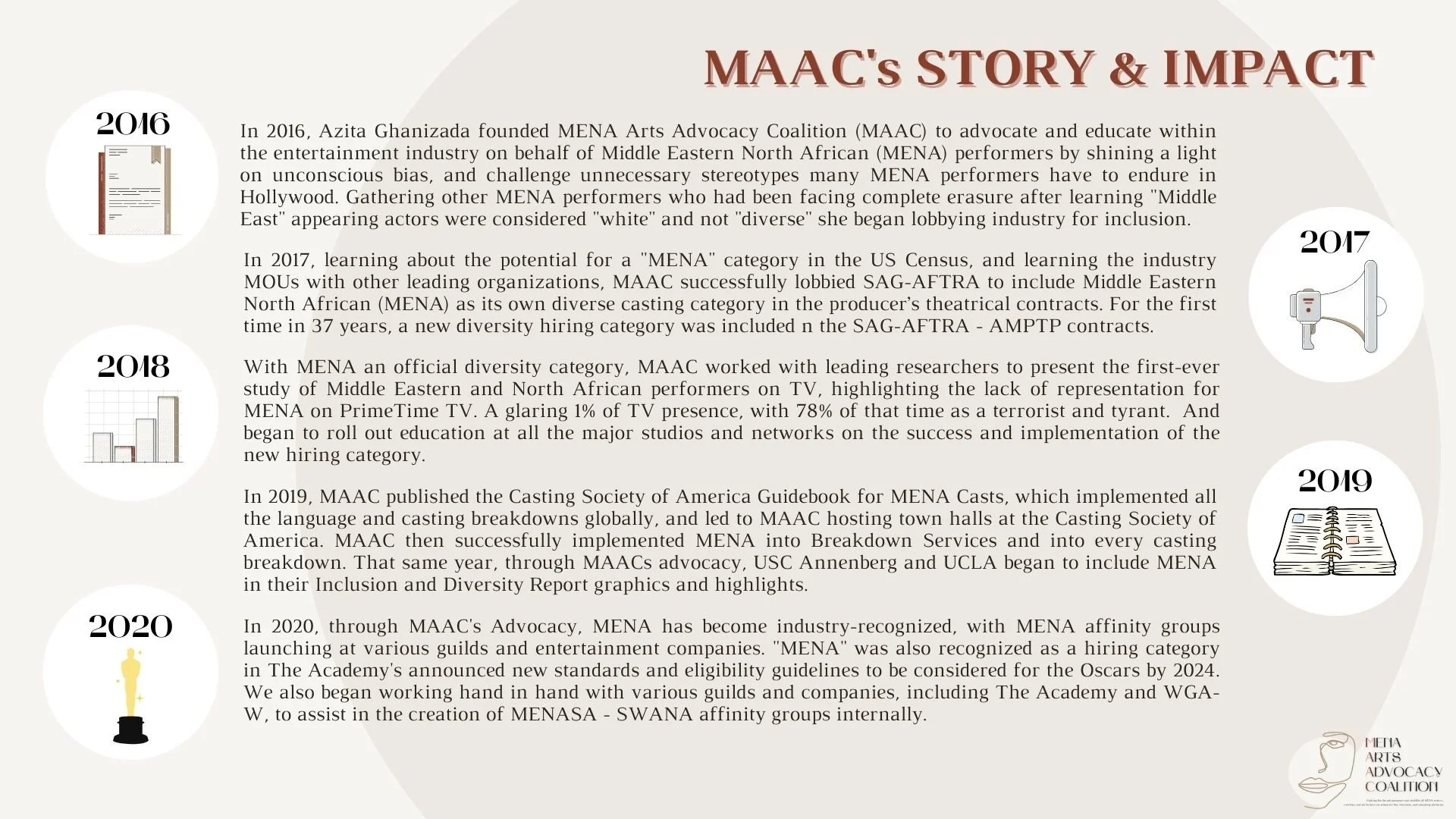
Our impact is far-reaching. In 2017, our successful lobbying for MENA inclusion in SAG-AFTRA-AMPTP contracts inadvertently set the industry standard for defining diverse communities and advancing greater inclusion. The addition of the MENA hiring category enabled us to illustrate, through detailed data, how MENA individuals are portrayed on screen. The release of the first study on MENA representation on television served as a rallying cry for executives, showrunners, writers, and studios to improve. Our findings have fueled global discussions about the often harsh portrayal of MENA performers. Our advocacy has led to universities and researchers tracking MENA representation, the creation of MENA and MENASA clubs across the US, and the emergence of MENA Arts organizations in the UK and Canada. We helped launch the WGA’s writers’ committee and secured MENA recognition in the Academy’s hiring standards for the Oscars.

*Please note: This graphic was created in 2019 and advised on by several academics who advised on the MENA category for the US Census. MAAC is not responsible for defining the region, or what is included in US data reporting. Since 2022, MAAC has aligned more closely to the term SWANA.


Our Story
In 2014, during a pilot table read at a major television network, our founder, Azita Ghanizada, faced a stark reality: she was labeled white. This label created a conflict for the show she was cast in, which had to report diversity hires and counted her among the few. Azita made it clear that she hailed from South/Central Asia and could rightfully be counted as Asian. However, her Middle Eastern appearance did not conform to traditional expectations, highlighting a glaring oversight in the industry’s hiring practices and in the inclusion of individuals from her region.
Refusing to accept this status quo, Azita took decisive action. She researched the lack of support for Middle Eastern North African (MENA) performers and quickly realized that Hollywood lacked any organization dedicated to protecting, serving, and advancing their interests. This realization was the catalyst for the creation of MAAC. From South/Central Asia, she could have focused on being counted as Asian. But her Middle Eastern appearance didn't look Asian at first glance, and Azita knew there was a major blind spot in hiring and including people from her part of the world. She immediately went home to research who could help her with this and quickly learned that no organizations in Hollywood specifically protected, served, and advanced the interests of Middle Eastern and North African (MENA) performers, so MAAC was born.

